Strategic Santa Clara County Downsizing for Estate Owners
For high-net-worth individuals managing significant real estate assets, Santa Clara County downsizing represents a complex financial transition requiring precise market timing. The shift from a sprawling legacy estate to a more streamlined luxury footprint is fundamentally a major liquidity event. We view this process through a strict analytical lens, examining how macroeconomic factors and localized supply constraints dictate optimal exit strategies. By interpreting the latest housing data, we can chart a clear path for extracting maximum equity while securing a high-quality replacement asset.
Table of Contents
- The Economics of Santa Clara County Downsizing
- Analyzing the Los Altos Estate Market
- Saratoga Market Dynamics for Legacy Sellers
- Analyzing Transaction Volume and Liquidity
- Structuring the Luxury Real Estate Transition
- Market Bifurcation and Listing Timing
- Identifying the Target Smaller Footprint
- Frequently Asked Questions
The Economics of Santa Clara County Downsizing
The current economic climate presents a distinct window of opportunity for owners of large-scale properties to reallocate their capital. Sustained wealth creation within the artificial intelligence sector and stabilization in long-term interest rates have created a highly motivated buyer pool for legacy estates. These buyers are flush with capital from restricted stock unit liquidations and are actively seeking properties that offer privacy and extensive square footage. Consequently, Santa Clara County downsizing allows current owners to capitalize on this heightened demand while moving their equity into more manageable, low-maintenance assets.
When we analyze the inventory levels across the region, the data reveals a persistent supply shortage that heavily favors sellers of premium estates. Markets with less than two months of supply are generally considered strong seller environments, and several localized micro-climates currently hover near 1.6 months of supply. This scarcity compresses the average days on market and drives upward pressure on the price-per-square-foot metric. Estate owners can leverage this supply-demand imbalance to command premium valuations for their large parcels before transitioning to a smaller luxury footprint.
Analyzing the Los Altos Estate Market
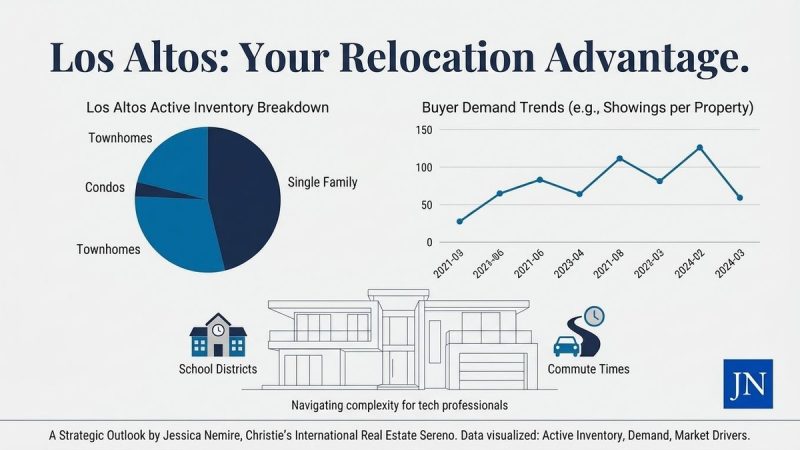
Los Altos remains a prime example of a micro-climate where macroeconomic tech wealth intersects directly with severe inventory constraints. The demand for legacy estates in this zip code is driven by buyers who prioritize proximity to venture capital hubs and top-tier educational infrastructure. Recent transaction volume data indicates that properties situated on half-acre or larger lots are experiencing accelerated absorption rates compared to the broader market. We consistently see buyers willing to pay a premium for expansive properties in Los Altos, creating an ideal exit environment for long-term owners.
To execute a successful sale in this specific sub-market, sellers must understand the concept of market bifurcation. Buyers are highly discerning and generally divide the market into turnkey properties and those requiring significant capital expenditures for renovation. Estates that have been meticulously maintained achieve significantly higher price-per-square-foot valuations and spend fewer days on market. Therefore, preparing a Los Altos property for a liquidity event requires a calculated assessment of the expected return on investment for any pre-sale property improvements.
Saratoga Market Dynamics for Legacy Sellers
Saratoga offers a slightly different statistical profile but presents equally compelling metrics for those initiating a real estate portfolio transition. This market is characterized by larger parcel sizes and a buyer demographic that values extreme privacy over immediate highway access. The data shows that Saratoga estates often have a slightly longer days-on-market average than Los Altos, but the ultimate transaction values remain highly robust. We track these nuanced differences closely to ensure our pricing models align with the specific absorption rates of the Saratoga micro-climate.
Homeowners in Saratoga planning a transition must evaluate their property valuation against the backdrop of local tech sector performance. When technology stocks perform well, we observe a direct correlation with increased transaction volume in the Saratoga luxury tier. By timing a listing to coincide with favorable macroeconomic indicators, sellers can maximize their capital extraction. This strategic approach ensures that the equity harvested from the Saratoga estate fully funds the acquisition of a specialized, smaller luxury property.
Analyzing Transaction Volume and Liquidity
Transaction volume serves as a leading indicator of overall market health and buyer appetite for large-scale real estate assets. When we analyze the trailing twelve months of data for Santa Clara County, we observe distinct spikes in transaction volume that correlate directly with major initial public offerings and corporate vesting schedules. These liquidity events inject substantial new capital into the local economy, immediately accelerating the absorption rate of available luxury housing. Estate owners who align their listing timelines with these corporate financial milestones often capture a significantly higher price-per-square-foot.
Conversely, ignoring these macro-level liquidity cycles can result in extended days on market and unnecessary price reductions. A property that sits active for more than forty-five days in a fast-moving micro-climate quickly becomes stigmatized, shifting the negotiating leverage entirely to the buyer. To mitigate this risk, we rely strictly on quantitative data models rather than anecdotal market observations to determine optimal pricing strategies. This data-first methodology ensures that the equity stored in a legacy estate is fully protected during the transition to a new asset.
Structuring the Luxury Real Estate Transition
Transitioning from a substantial estate to a smaller luxury property requires careful financial structuring to prevent unnecessary tax liabilities or logistical friction. One critical metric to consider is the cost of capital, particularly if bridge financing is utilized to secure the replacement property before the legacy estate closes. Many of our clients opt to execute all-cash purchases for their new, smaller footprint by leveraging portfolio loans against their broader investment holdings. This strategy allows them to act decisively in competitive micro-climates like Campbell or Willow Glen without making their offers contingent on the sale of their primary residence.
Furthermore, analyzing the capital gains implications of a high-value real estate sale is an essential component of the planning phase. While primary residences generally do not qualify for commercial exchange deferments, sellers must carefully calculate their cost basis, including decades of capital improvements, to understand their net proceeds. We collaborate closely with tax advisors to ensure that the projected liquidity from the estate sale is accurately forecasted. A precise financial model empowers clients to target their next real estate acquisition with absolute confidence in their purchasing power.
Market Bifurcation and Listing Timing
Timing the market involves more than just observing seasonal trends; it requires an ongoing analysis of localized transaction volume and buyer sentiment. The phenomenon of market bifurcation means that while premium, updated estates sell rapidly, properties with deferred maintenance may languish even in a low-inventory environment. We advise our clients to study the price-per-square-foot differentials between these two categories in their specific zip codes. By understanding this data, estate owners can make informed decisions about whether to list their property as-is or deploy capital to elevate the asset into the premium tier.
Interest rate stabilization plays a crucial role in buyer psychology, even in the ultra-luxury segment where cash transactions are prevalent. When macroeconomic borrowing costs become predictable, buyers feel more secure liquidating other assets to fund major real estate purchases. This predictability increases the overall liquidity in the housing market, making it easier for owners of legacy estates to find qualified buyers. Monitoring these macroeconomic shifts allows us to identify the precise moment when market conditions are mathematically optimal for a high-value listing.
Identifying the Target Smaller Footprint
Securing a smaller footprint does not equate to a reduction in asset quality; rather, it represents a strategic shift toward high-end, low-maintenance living. Markets such as Willow Glen, Los Gatos, and Campbell offer premium single-level homes and luxury townhomes that appeal strongly to buyers exiting massive estates. These properties maintain high price-per-square-foot valuations because they offer walkable access to amenities and streamlined floor plans. We track the inventory levels of these specific property types meticulously, as their scarcity often makes them more competitive than the large estates our clients are leaving behind.
The data clearly indicates that demand for premium, downsized properties in Santa Clara County is outpacing the available supply. Buyers must enter these micro-climates armed with robust financial documentation and a clear understanding of local absorption rates. By structuring the exit from the legacy estate optimally, our clients possess the liquid capital required to win competitive bidding scenarios. To explore how these dynamics might apply to your specific real estate assets, you can review our strategic approach with a dedicated real estate analytical partner.
Frequently Asked Questions
What is the current supply for legacy estates?
The months of supply metric varies significantly by specific micro-climate within the broader region. Currently, localized areas like Los Altos are experiencing roughly 1.6 months of supply for large estates, indicating a strong seller advantage. We continuously monitor this data to help clients pinpoint the most advantageous time to initiate their transaction.
How do stable rates impact all-cash buyers?
Even for high-net-worth buyers who do not require traditional mortgages, stable interest rates foster overall economic confidence. When rates stabilize, equity markets generally perform better, which increases the value of the stock portfolios that buyers often liquidate to purchase real estate. Therefore, macroeconomic rate stability directly supports higher transaction volumes in the luxury housing tier.
What defines a smaller luxury footprint?
A smaller luxury footprint refers to a property with reduced square footage and minimal exterior maintenance requirements that still features premium finishes and locations. These assets typically include high-end single-level homes or luxury townhouses situated in highly walkable neighborhoods. From an investment perspective, these properties exhibit strong price appreciation due to heavy demographic demand and limited new construction.
Why is price-per-square-foot an imperfect metric?
While price-per-square-foot provides a baseline for market analysis, it often fails to account for the premium placed on expansive lot sizes and extreme privacy. Legacy estates typically feature extensive grounds, specialized outbuildings, and custom architectural elements that skew standard valuation models. Therefore, we use a hybrid analytical approach that factors in both the structural square footage and the intrinsic value of the land itself. This ensures our pricing accurately reflects the true market value of unique, large-scale assets.